Introduction
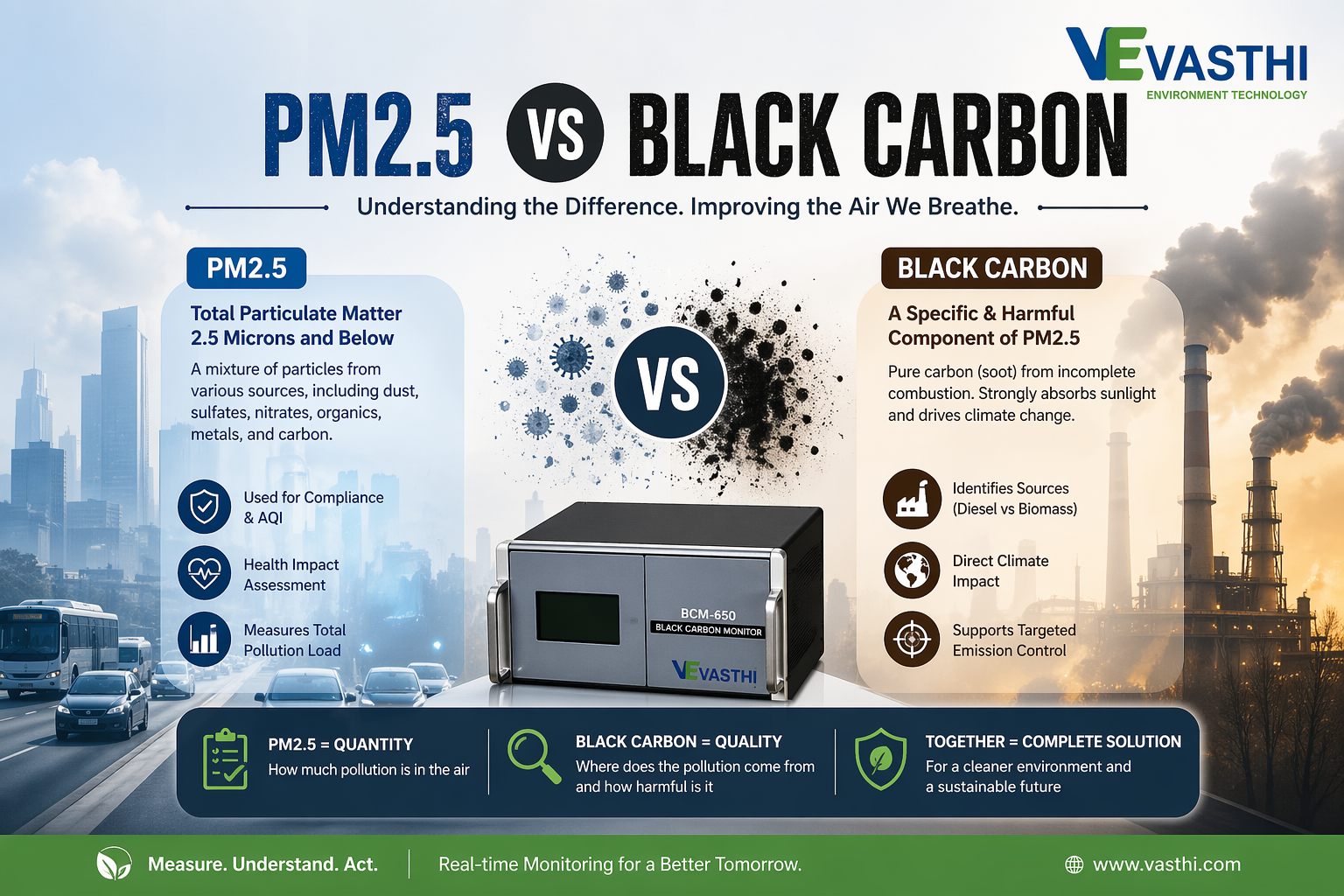
PM2.5 and black carbon are often confused because they are closely related in air pollution studies. However, they serve very different purposes in environmental monitoring. Understanding their differences is essential for accurate air quality assessment, pollution control, and climate analysis.

What is PM2.5?
PM2.5 refers to particulate matter with a diameter of 2.5 micrometers or less. It includes a wide range of substances such as:
- Dust
- Sulfates
- Nitrates
- Organic compounds
- Metals
- Carbon particles
PM2.5 is mainly used for:
- Regulatory compliance
- Public health assessment
- Air Quality Index (AQI) calculations
What is Black Carbon?
Black carbon is a specific component of PM2.5 produced only from combustion processes.
It is:
- Pure carbon (soot)
- Highly light-absorbing
- Strongly linked to climate warming
Black carbon is considered one of the most harmful air pollutants due to its impact on both health and climate.
Detailed Comparison
| Aspect | PM2.5 | Black Carbon |
|---|---|---|
| Nature | Broad category of particles | Specific pollutant (subset of PM) |
| Measurement Unit | µg/m³ | ng/m³ |
| Measurement Method | Gravimetric / optical | Optical absorption (aethalometer) |
| Source Insight | Limited | High (diesel vs biomass) |
| Climate Impact | Indirect | Direct and significant |
| Composition | Mixed (organic + inorganic) | Elemental carbon |
| Use Case | Compliance monitoring | Advanced diagnostics |
Why PM2.5 Alone is Not Enough
PM2.5 indicates the quantity of pollution, but it does not provide information about the source or composition.
For example:
- Two locations may have the same PM2.5 levels
- One may be dominated by dust
- Another may be dominated by diesel emissions (black carbon)
The environmental and health impacts in both cases are very different.
Why Black Carbon Adds Value
Black carbon monitoring provides deeper insights into pollution sources and impact.
It helps in:
- Identifying pollution sources
- Evaluating combustion efficiency
- Designing targeted emission control strategies
- Assessing climate impact
This is especially useful in:
- Urban traffic studies
- Industrial emission monitoring
- DG set emission analysis
- Environmental policy and research
Simple Understanding
PM2.5 represents the total pollution load, while black carbon represents the combustion-related and most harmful fraction of that pollution.
Why Both Should Be Used Together
A complete air quality monitoring system should include both PM2.5 and black carbon measurements.
- PM2.5 is essential for compliance and public health monitoring
- Black carbon is essential for source identification and climate impact analysis
Together, they provide:
- Complete understanding of pollution levels
- Source identification and control strategy
- Better environmental decision-making
Conclusion
While PM2.5 helps measure overall air pollution, black carbon provides critical insights into pollution sources and climate impact. Using both parameters together ensures a more accurate and effective approach to air quality monitoring and environmental protection.